The amperage you can actually use.
Home chargers are sold on a maximum: 40 amps, 48 amps, 50. Most buyers will never see that number, because two other things decide the charging rate first — the breaker your panel can spare, and what your car is willing to accept. Both are knowable before you spend anything, and this page is the arithmetic.
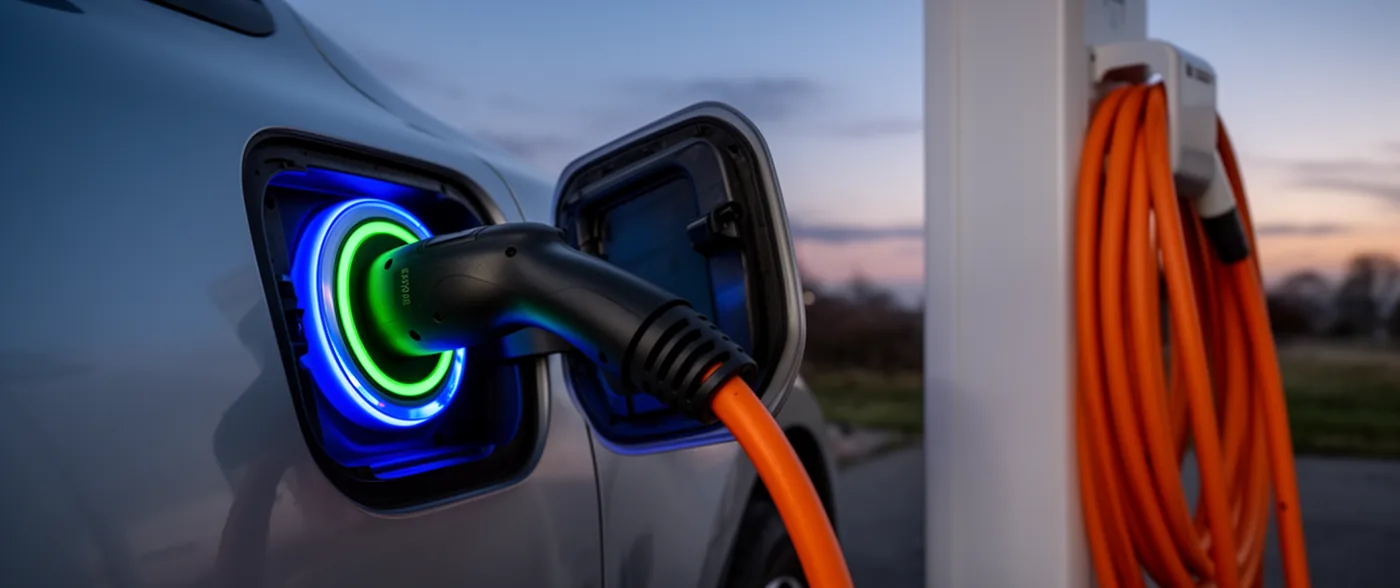
Three numbers, and only one is yours to choose
- The charger's maximum. The number on the box. The easiest of the three to change, and the one people shop on.
- The circuit. Fixed by your panel and by what an electrician can run to the garage. Changing it is the expensive one.
- The car's onboard charger. Fixed at the factory and not upgradable. Changing it means changing the car.
The rate you get is the lowest of the three. Buying a 48-amp charger for a 40-amp circuit and a car that accepts 32 amps buys you 32 amps, and a slightly heavier box on the wall.
The 80 per cent rule
Car charging is a continuous load — it draws hard for hours — and the electrical code requires the circuit to be rated well above the draw for that reason. In practice the charger may use 80 per cent of the breaker's rating, which is the same as saying the breaker must be 125 per cent of the charger setting.
government guidance US Department of Energy, Plug-In Electric Vehicle Handbook for Electrical Contractors, April 2012. The federal handbook written for the contractors who install this equipment, and it states the classification the whole calculation rests on in its own words: "EVSE is considered a continuous load by the National Electrical Code (NEC)", and "NEC Article 625 contains most of the information applicable to EVSE." Read it for that and for nothing more. It does not state the 125 per cent sizing factor, and the words "80 percent" and "percent" do not appear in it at all — checked by extracting the text, not by skimming. It is also April 2012 (DOE/GO-102012-3276) and Article 625 has been revised since, so it is authority for the classification and for none of the current numbers.
That source is narrower than the paragraph above it. It supports one thing there — that the code classifies car charging as a continuous load — and nothing else. Not that the circuit must be rated above the draw, and not the size of the margin. Both of those are sizing requirements and the handbook states neither. The 125 per cent factor is the electrical code's rather than ours, and we are not going to tell you which section of it, because we have not read the code — NFPA publishes the text free, but only behind a sign-in. Naming a section we had not opened would be the thing this page is about. So the arithmetic below stays labelled as arithmetic, and the figure to confirm with your electrician rather than with us.
| Charger set to | Power at 240 V | Breaker required |
|---|---|---|
| 16 A | 3.84 kW | 20 A |
| 24 A | 5.76 kW | 30 A |
| 32 A | 7.68 kW | 40 A |
| 40 A | 9.60 kW | 50 A |
| 48 A | 11.52 kW | 60 A |
Arithmetic, not a measurement, so there is no source line: power is volts × amps, and the breaker is the charger setting ÷ 0.8 taken up to the next standard size. Car and Driver states the same relation in its own test — 240 volts drawing 32 amps is 7.7 kilowatts. Your local code and your electrician are the authority on what your panel will take; this table tells you what to ask them for.
This is why so many people end up at 40 amps. The Car and Driver editor who ran that test landed there for exactly this reason: a 40-amp circuit fitted the existing service, and a 50-amp one would have meant paying to upgrade it.
What it will actually cost you in hours
Charging time is the energy you need divided by the power you are getting. Put your own numbers in.
The time assumes 90 per cent of the power reaching the battery; the rest is lost as heat in the cable, the onboard charger and the pack. That is a stated assumption, not a measurement — real losses vary with temperature and state of charge, and a cold battery in winter will be slower than this figure.
Your car may cap it anyway
Every EV has an onboard AC charger with a fixed ceiling, and it is often lower than buyers assume. If yours accepts 32 amps (7.7 kW), a 48-amp wall unit on a 60-amp circuit charges it at exactly the same speed as a 32-amp unit on a 40-amp circuit — and the second setup is considerably cheaper to install.
The figure is in your owner's manual, usually as a kW rating rather than amps. Divide by 240 and multiply by 1000 to get amps: a 7.7 kW onboard charger is 32 amps, an 11.5 kW one is 48.
Buy for the car you will have next, not only the one you have now, if the extra circuit capacity is cheap to run while the walls are open. Capacity is easy to add during an installation and expensive to add afterwards. That is a judgement, not a measurement.
So what should you buy?
Almost every mainstream unit now offers a selectable output, so the honest advice is that the amperage rating is rarely the thing to choose on — you will set it to what your circuit allows anyway. What differs between units is duller and matters more: cord length, whether it is rated for outdoor mounting, and whether the lower output settings need it hardwired rather than plugged in.
Three figures from Car and Driver's test that are worth knowing, all manufacturer specifications: the Lectron Level 2 has a 16 ft cord, which is short if the charge port is on the far side of the car; Tesla's Universal Wall Connector is the only unit that reaches 50 amps, at 12.0 kW, which by the rule above needs a 70-amp circuit to use — not the 60 a 48-amp unit takes; and the Grizzl-E Duo carries two 24 ft cables for households charging two cars from one circuit.
We have not published a full comparison table here. The test we sourced lists more specification blocks than it does unambiguous product headings, and at least one output rating could not be matched to its charger with certainty — so a table would have meant guessing which number belonged to which box. Not printing it was the cheaper mistake.