It clicks. What the clicking tells you.
Turn the key, get clicking, engine does not turn. Almost every answer online is written by somebody who would like to book you in, and almost all of them stop at the same rule of thumb. The rule is sound. What none of them give you is the one measurement that settles it, or the reading that looks healthy and is not.
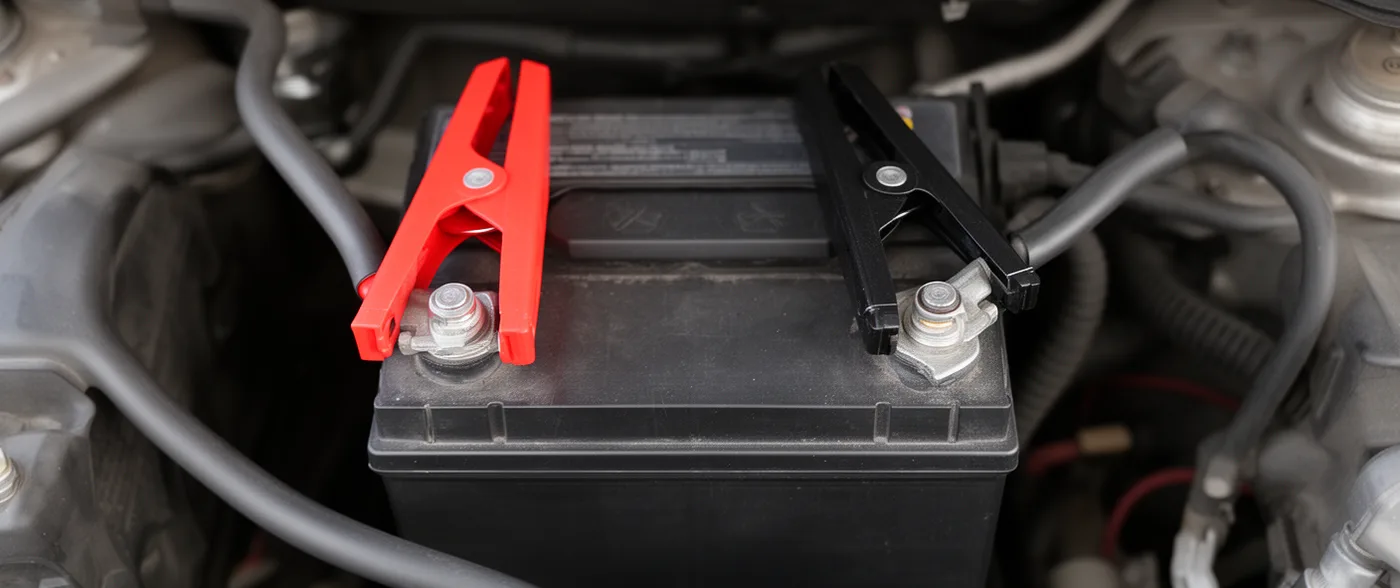
First, listen to the clicks
Two national chains describe the same distinction independently, and it is worth having before you touch anything:
Rapid clicking, several a second battery side
There is enough current to pull the starter solenoid in, but not enough to hold it while the motor draws. It snaps in, the voltage collapses, it drops out, and it repeats. Battery, terminals or cables.
One loud click, then silence starter side
The solenoid closed and stayed closed, and the motor did not turn. That points at the starter motor — or at a battery so flat it managed exactly one engagement and nothing after.
It is a good first cut and it is not a diagnosis, because the second case has two quite different causes. A meter separates them.
The number that settles it
A 12 V lead-acid battery's resting voltage maps to its state of charge, and this table is not one publication's opinion — four independent sources give the same figures to the tenth of a volt. Rested means several hours after the engine last ran; measure it right after a drive and the surface charge flatters it.
| Rested reading | Charge | What it means |
|---|---|---|
| 12.6 V or above | 100% | Healthy and full |
| 12.4 V | 75% | Usable, worth charging |
| 12.2 V | 50% | Low. Charge it |
| 12.0 V | 25% | Deeply discharged |
| Below ~11.8 V | 0% | Effectively flat |
The span from full to flat is under a volt. That is why “it reads twelve-something” tells you almost nothing and the first decimal place tells you almost everything.
The reading that looks fine and is not
Here is the part the chains leave out. A battery can rest at a perfectly healthy 12.6 V and still collapse the moment the starter draws. Resting voltage measures how much charge is in it. It does not measure whether the battery can still deliver that charge fast, which is the thing that has failed on most batteries that die.
The load figure is the one to take: with a meter on the terminals and somebody cranking, a healthy battery does not fall below 9.6 V. All four sources give the same threshold.
Scale runs to 14.7 V, the highest measured value here.
use it Convergent, four independent sources, 12 V battery state-of-charge and cranking voltage, read 31 July 2026. The open-circuit voltage table for a 12 V lead-acid battery is not one publication's claim: four independent sources we read give the same figures to the tenth of a volt — 12.6 V rested is full, 12.4 V is about 75 per cent, 12.2 V about 50, 12.0 V about 25, and below roughly 11.8 V effectively flat. All four also give the same load threshold: a healthy battery does not fall below 9.6 V while the engine is cranking. Measure rested, meaning several hours after the engine last ran.
Rested above 12.4 but falling under 9.6 while cranking is a battery that is charged and finished. Rested at 12.0 and recovering after a charge is a battery that was flattened by something — a door left ajar, a short trip, a failing alternator — and the cause matters more than the battery does. That is what the third row is for: if the engine runs but the charging voltage never reaches about 13.7, the alternator is not putting it back and a new battery will die too.
A jump pack is also a diagnostic
If you have no meter, a jump pack answers the question by itself:
- It starts and keeps running — the battery was flat. Find out why before buying a new one.
- It starts, then dies as soon as you disconnect — the alternator is not charging.
- It still clicks exactly the same way — the battery was not the problem. That is the starter or a cable, and no jump pack of any size will fix it.
That third case is worth knowing before you spend anything: people buy a bigger pack to solve a starter fault, and a bigger pack cannot.
The failure that catches people out
When a battery is flat enough to give a single click, some lithium jump packs refuse to run at all — they read the near-zero voltage as a reverse-polarity fault and will not engage. In the test we sourced for our jump starter page, packs without a manual override button could not be made to work; one had to be dropped from the test and another needed a fresh battery fitted first before it would agree to help.
So the feature to check on a jump pack is not the amperage on the front. It is whether there is a manual override, and whether it publishes a cold cranking figure at all — two of the seven units in that test state no sustained figure whatsoever, and one of them advertises the largest peak of the lot.
When it is not the battery
- Corroded or loose terminals produce exactly the rapid-click symptom on a good battery. Look before you buy: white or blue crust, or a terminal you can twist by hand.
- Age. Three to five years is the ordinary lifespan. A battery that starts the car all summer and fails on the first cold morning is not unlucky — cold raises what the starter needs at the moment the battery can give least.
- No click, no lights at all is a different fault: a completely dead battery, a disconnected terminal, or a main fuse.
- It cranks normally and simply will not fire — then the electrical side is fine and this page is not your answer.
use it Convergent, four independent sources, 12 V battery state-of-charge and cranking voltage, read 31 July 2026. The open-circuit voltage table for a 12 V lead-acid battery is not one publication's claim: four independent sources we read give the same figures to the tenth of a volt — 12.6 V rested is full, 12.4 V is about 75 per cent, 12.2 V about 50, 12.0 V about 25, and below roughly 11.8 V effectively flat. All four also give the same load threshold: a healthy battery does not fall below 9.6 V while the engine is cranking. Measure rested, meaning several hours after the engine last ran.
marked AutoZone and Firestone, Car won't start and is making clicking noises, read 31 July 2026. Two national service chains, independently, describe the same distinction: rapid clicking several times a second points to a battery that can trigger the solenoid but cannot hold the current to spin the starter, while a single loud click followed by silence points to the starter motor or to a battery flat enough to close the solenoid once and no more. Marked rather than measured because both sell the repair, and because neither publishes a measurement behind the distinction.
not measured Nobody publishes how far below 9.6 V a battery has to fall before a given starter refuses, or how much of the drop is the battery and how much is the cables. The threshold is a pass or fail, and where it fails it does not tell you which part failed.