1.6 mm is where it becomes illegal, not where it becomes bad.
A report written for the European Commission reproduces braking tests on four vehicle types and says that below 3.5 mm of tread “the stopping distance increases rapidly”, and that “the stopping distance increases in a range of 30 % to 65 % at the legal limit of 1.6 mm”, measured from 80 km/h. The report does not state what that increase is measured against, so take it as the size of the effect rather than a figure for your car.
The legal minimum is a floor, not a target
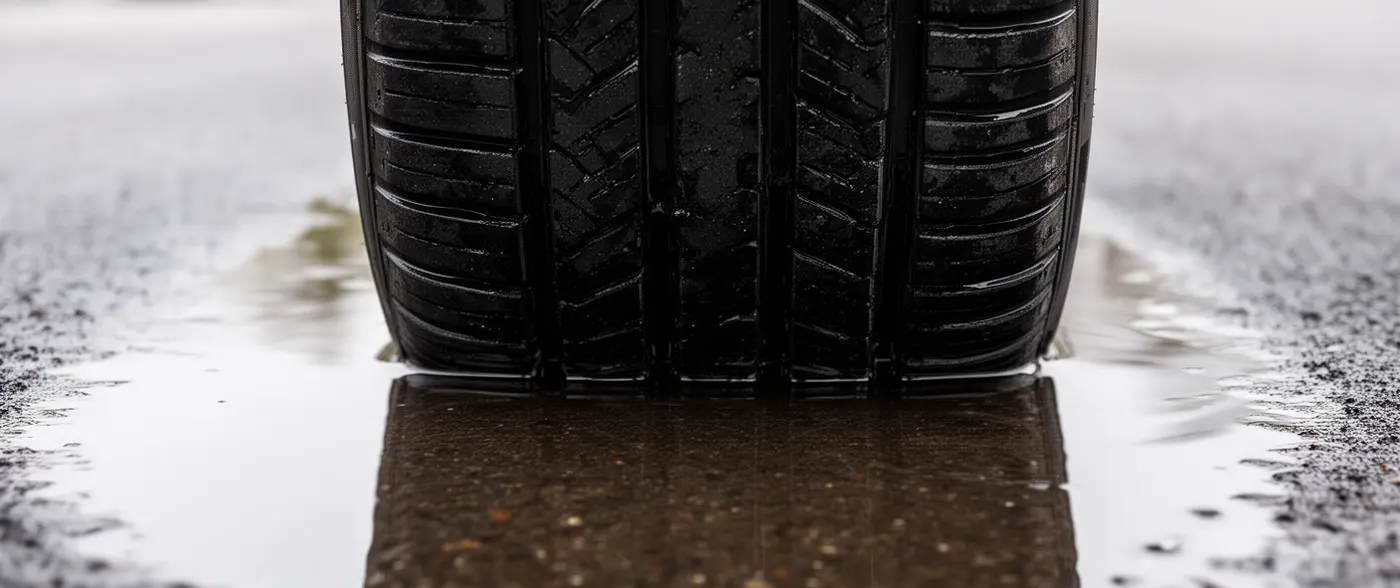
Tread does one job in the rain: it gives water somewhere to go. With less of it, less water moves, and the tyre spends more of its contact patch floating rather than gripping. That is the usual explanation for why wear costs so little and then so much — and it is ours, not TNO’s: the report does not state whether MIRA’s tests were wet at all, so the mechanism fits the curve rather than being measured alongside it.
It is a range, and the report does not say what produces it. TNO reproduces studies run by MIRA in 2003 and 2004, plotting the average increase across four vehicle types — so the between-vehicle spread has already been taken out, and the 30–65 % band is not simply four cars disagreeing. It states no surface, no water depth and no tyre models, and it is a stakeholder discussion document rather than a final report. Treat it as the shape of the curve.
Where the curve turns
The useful part is not the number at the limit but where the curve turns. TNO’s sentence is that “below 3.5 mm of tread depth, the stopping distance increases rapidly”; reading that as a turning point is ours. Above it, wear costs a little at a time; below it, the same millimetre costs more than the one before.
One demonstration, four cars, and a margin too small to lean on
Depth is not the only variable, and the clearest demonstration of that comes from a party with an interest in making it. Michelin drove 4 identical cars through the same wet braking test — 1 mm of water, 80 down to 20 kph — on new and worn tyres of two price tiers. Note the second number: none of these cars stopped. The run ends at 20 kph, and the last 20 kph is where a worn tyre gives up most, so these distances are not comparable with TNO’s stopping distances above and are not laid against them here.
| Product | Wet braking m, 80–20 kph in 1 mm of water marked |
|---|---|
| Mid-range, new | 19.2 |
| Mid-range, worn Within 0.6 m of the new budget car — too close to separate | 22.1 |
| Budget, new | 22.7 |
| Budget, worn Longest run of the four | 27.6 |
marked Tyre Reviews, reporting Michelin, Should we change tyres at 3mm? Michelin say no, May 2017. A demonstration Michelin ran, funded and hosted at its own test facility in Clermont-Ferrand, reported by Tyre Reviews: "we drove four identical vehicles, the first with new mid range tyres, the second with worn mid range tyres, the third with new budget tyres, and the fourth with worn budget tyres, and placed them through a wet braking test in 1mm of water from 80 - 20 kph". WHAT IT DOES NOT STATE is as important as what it does: the article gives no tread depth for the worn tyres, names no tyre models, and does not say whether they were worn on the road or machine-shaved — and Michelin's commercial interest lies in tyres being judged worn rather than new. Its own author writes of the opposite campaign that "the cynic might have another view".
Two comparisons come out of 4 figures. Moving up a tier was worth 3.5 m between the two new cars and 5.5 m between the two worn ones. Wear cost 2.9 m on the mid-range car and 4.9 m on the budget one. They are the same order of size, which is the finding: neither one dominates.
The worn mid-range car and the new budget car finished within 0.6 m of each other — 22.1 against 22.7. That is under three per cent, from single runs with no repeats and no stated tolerance, at a demonstration the manufacturer funded. It is enough to say the two ranges overlap. It is not enough to say a worn tyre beat a new one, and an earlier draft of this page said exactly that.
And for the budget car, wear cost more than the tier gap did. 4.9 m against 3.5 m. So the reader most likely to be running worn cheap tyres is the reader for whom wear mattered most — which is the opposite of the comfortable conclusion, and it is in the same four numbers.
Who tells you when to replace, and what they sell
Every figure above was produced by somebody with a reason to produce it, and on this subject that is unusually worth saying out loud.
- Michelin ran, funded and hosted the demonstration at its own facility, and its argument is that you should not replace at 3 mm. That is advice about when to buy, not a proposal to change the law, and it happens to be the argument a demonstration like this one supports.
- The advice it argues against has an interest of its own. Telling drivers to replace at 3 mm rather than 1.6 mm shortens the life of every tyre sold. Neither source says who promotes it, so this is an observation about incentives and not a claim about anybody; the article reporting the demonstration allows only that “the cynic might have another view”.
- The TNO document is the least interested — commissioned by a regulator rather than a seller — and it is also the vaguest: a discussion document, reprinting figures from 2003 and 2004 without stating the conditions they were taken under.
What to do
Before the list: neither source states how worn the “worn” tyres were. Michelin’s demonstration gives no tread depth for them, no models, and no word on whether they were worn on a road or cut down by a machine. Nothing on this page tells you it is safe to run a tyre toward 1.6 mm, because nothing on this page measured one there.
- Measure it. A tread depth gauge costs very little and reads in both 32nds and millimetres. The wear bars moulded into the grooves only show you 1.6 mm — the EU and UK legal floor, and the same depth as the 2/32 in minimum most US states set — by which point you are well past the turn in the curve.
- Plan around 3.5 mm, not 1.6. That is where TNO’s sentence puts the change in behaviour, and it leaves a season of margin instead of a fine.
- Buying better is not an alternative to replacing on time. In Michelin’s own four figures the two were the same order of size, and for the budget car wear cost the more of them. Do both; neither buys you the other.
Tread depth gauges on Amazon Affiliate link — we earn a commission at no extra cost to you, and it does not change what is written above. See our disclosure.
Tyres on Amazon A fitment search, not a listing — your size is on the sidewall and on the driver’s door jamb. This page ranks no tyre, because neither source names one. Affiliate link; see our disclosure.
What nobody has measured
Nobody in either source states the tread depth of the “worn” tyres. Michelin’s demonstration does not, and it is the measurement its own argument rests on; TNO’s curve gives depths but not the tyres or the surface. So the two cannot be laid over each other, and this page does not try.
Nor does anyone publish, in a form a reader can check, how a tyre worn on a road for two years compares with one machine-shaved to the same depth. Neither source addresses it — the objection is ours, and it applies squarely to the demonstration in the table above.
use it TNO and TML, for the European Commission, Study on some safety-related aspects of tyre use — stakeholder information and discussion document, May 2014. Commissioned by the European Commission's transport directorate under MOVE/C4/2013-270-1. THE BRAKING FIGURES ARE NOT TNO'S OWN: the report reproduces "studies conducted by MIRA in 2003 and 2004 on 4 different vehicle types", plotting the average increase in stopping distance from 80 km/h against tread depth. From that curve TNO states that "below 3.5 mm of tread depth, the stopping distance increases rapidly" and that "the stopping distance increases in a range of 30 % to 65 % at the legal limit of 1.6 mm". It is a discussion document rather than a final report, and it does not state the surface, the water depth or the tyre models MIRA used.
marked Tyre Reviews, reporting Michelin, Should we change tyres at 3mm? Michelin say no, May 2017. A demonstration Michelin ran, funded and hosted at its own test facility in Clermont-Ferrand, reported by Tyre Reviews: "we drove four identical vehicles, the first with new mid range tyres, the second with worn mid range tyres, the third with new budget tyres, and the fourth with worn budget tyres, and placed them through a wet braking test in 1mm of water from 80 - 20 kph". WHAT IT DOES NOT STATE is as important as what it does: the article gives no tread depth for the worn tyres, names no tyre models, and does not say whether they were worn on the road or machine-shaved — and Michelin's commercial interest lies in tyres being judged worn rather than new. Its own author writes of the opposite campaign that "the cynic might have another view".