“Your brakes are at 4.”
Four what?
It is handed over at a counter, usually with a quote attached, and almost nobody explains it. The number is millimetres of friction material left on the pad. What follows from that is one piece of arithmetic nobody performs out loud, and it is not in your favour.
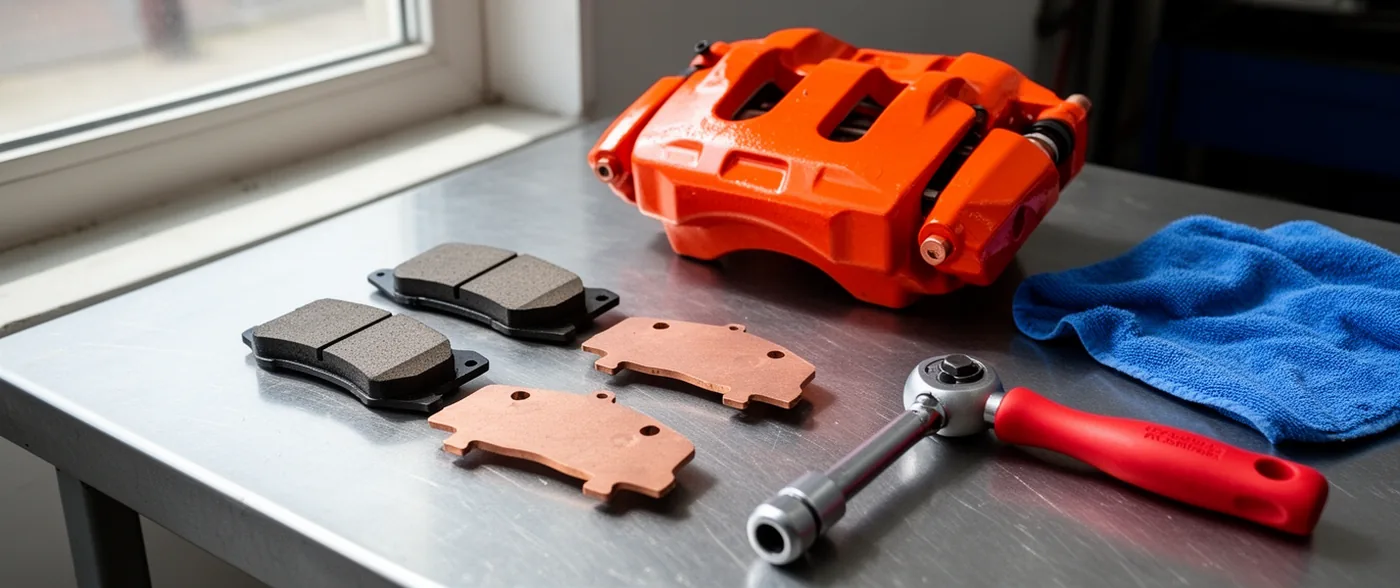
A number with no unit
There is no standard for how a shop reports pad wear. Most quote millimetres. Some quote a percentage. Some use a 1–10 scale on an inspection sheet. The scales are not interchangeable, and a “4” on one sheet is not a “4” on another.
Before anything else, ask two questions: “Millimetres or percent?” and “Front or rear?” Without both, the number cannot be acted on — and the rest of this page cannot be applied to it.
Three millimetres you can never use
Brembo publishes both ends of the range: new pads are approximately 10 to 12 mm of friction material, and below 3 mm they are due for replacement. That second figure is the one that changes the arithmetic, because it means 3 mm of every pad is material you can never use.
So a pad that measures half its original thickness has nothing like half its life left. Subtract the 3 mm you will never reach, and:
- 10 mm when new 5 mm measured is 50% of the thickness but only 29% of the usable life
- 12 mm when new 6 mm measured is 50% of the thickness but only 33% of the usable life
This is why “you’ve got about half your brakes left” is comforting and wrong. Half the thickness is about a third of the life, because the bottom 3 mm was never yours to spend — and after that every millimetre costs the same slice of the usable life as the one before it, right down to the wear limit.
What your reading actually means
| Measured | Usable life left | What to do |
|---|---|---|
| 10 mm | 78–100% | Plenty left. |
| 8 mm | 56–71% | Plenty left. |
| 7 mm | 44–57% | Plenty left. |
| 6 mm | 33–43% | Fine to drive. Check again at the next service. |
| 5 mm | 22–29% | Fine to drive. Check again at the next service. |
| 4 mm | 11–14% | Book it. This is the last tenth. |
| 3 mm | 0% | At or past Brembo's replacement figure. Replace. |
Computed when this page is built, from the two published figures above and nothing else: usable life is (measured − 3) as a share of (when new − 3). The range spans pads that were 12 mm new at the low end and 10 mm new at the high end — a thicker new pad means a given reading is a smaller share of its life.
So “at 4” means roughly 11–14% of the usable material is left. That is not an emergency and it is not scaremongering either: it is close to the end, and the honest answer is to book the work rather than to do it that afternoon.
The rotor carries its own answer
The rotor is the one part of a car that carries its own specification on its face. Cast or etched into it is MIN TH followed by a figure in millimetres. There is nothing to look up and nobody to trust: the number that decides is on the object.
Brembo's procedure is worth following exactly, because two of its three steps are the ones people skip:
- Measure at four points or more, not one. A rotor does not wear evenly, and one reading can miss the worn part entirely.
- Take the lowest reading as the value for the whole rotor.
- Replace in pairs even when only one side is under the limit.
Brembo's general rule is that rotors are replaced at every second pad replacement. If you are being sold rotors at every pad change, that is worth a question; if you are being sold pads alone for the third time, so is that.
Front and rear do not wear together
Brembo gives front pads 25,000 to 50,000 km — about 15,500 to 31,000 miles — and says rear pads last roughly twice as long. The front does most of the braking, because weight transfers forward every time you slow down.
Which is why “your brakes are at 4” is an incomplete sentence. Fronts at 4 mm with rears at 8 is an ordinary, expected state of affairs, and it is a front-axle job.
Buy the gauge, not the guess
This is the rare case where the useful purchase is the measurement, not the part. Pads and rotors are specific to your car; a gauge is not, costs less than the diagnostic fee, and settles the question in your own driveway before anyone quotes you.
We are not linking pads or rotors to a specific listing. Both are specific to your exact model, year and often trim, so a single link would send most readers to a part that does not fit. Search your car's own fitment instead, and note that the rotor you take off tells you the MIN TH you need the new one to beat.
- Brake pads and rotors on Amazon Filter to your vehicle before buying — fitment decides this, not brand
Affiliate links — we earn a commission at no extra cost to you and it does not change what we recommend. How this site makes money.
What nobody has measured
- What a worn pad costs you in stopping distance. No published test brakes the same car at 8 mm and again at 3.5 mm and reports the metres. The 3 mm figure is a manufacturer's threshold, not a measured cliff edge, and nobody has drawn the curve.
- Whether expensive pads last longer. There is no independent wear test across brands on one car. Every claim about budget pads wearing faster is a claim, including the ones made by people selling the expensive ones.
- Your car's own numbers. The 10–12 mm and 3 mm figures are general. Your manufacturer's service schedule may set a different limit, and where it does, it wins.
marked Brembo, How can I tell if my brake pads are worn?, July 2026. A brake manufacturer's own maintenance guidance, not an independent test. It states that new pads are approximately 10-12 mm thick and are due for replacement below 3 mm, and gives front pad life as 25,000-50,000 km with rear pads lasting about twice as long. These are general figures across vehicles; your car's own service schedule takes precedence over them.
marked Brembo, Minimum brake rotor thickness, July 2026. The manufacturer's procedure for the rotor wear limit: measure with a gauge at a minimum of four points and take the lowest reading, then compare it against the MIN TH value etched onto the rotor itself. Rotors are to be replaced in pairs even when only one is under the limit, and as a general rule at every second pad replacement.
arithmetic The usable-life percentages are ours, computed when this page is built from Brembo's two published thickness figures. They are arithmetic on a manufacturer's specification, not a measurement of anything, and both figures carry the “marked” flag for that reason.