Turning the fan up makes the filter worse.
Car cleaning is a category almost nobody has measured — every “best car shampoo” list is somebody’s opinion. The air inside the cabin is the exception. It has been measured, in peer-reviewed work, and what it says contradicts most of what the aisle sells you.
The fan setting changes the filtration
Renck and Jung measured particles inside vehicle cabins across a range of fan speeds and found that the built-in cabin filter’s efficiency for particles drops significantly as the fan speed increases. The authors state this is the first study to show it. It is the only finding on this page that costs nothing to act on.
The mechanism is ordinary filtration physics: push air through a filter faster and a smaller share of the particles get caught. What is remarkable is that nobody tells you, and that the instinct in bad air — heavy traffic, a tunnel, a lorry in front — is to turn the fan up.
The practical version: in bad air, switch to recirculate rather than reaching for a higher fan speed. All of this study’s fan-speed testing was done in fresh-air mode, which is the mode that draws outside air in.
Cheap and OEM are not the same filter
The same study measured nitrogen dioxide, the pollutant that comes with traffic. Two OEM filters with an activated carbon layer cut NO2 by 64 to 67 per cent. The inexpensive aftermarket filters showed no reduction at all.
Scale runs to 67 %, the highest measured value here.
use it Renck and Jung, Environmental Science: Processes & Impacts, The effect of portable air purifiers and cabin air filters on particulate matter and nitrogen oxides concentrations in vehicle cabins, September 2025. Peer-reviewed. Particulate matter and nitrogen oxides measured inside vehicle cabins across a range of HVAC fan speeds, all in fresh-air mode, comparing the car's own filter against OEM and aftermarket filters with carbon layers and against portable purifiers from about 80 to 8,500 litres per minute. The authors state this is the first study to show that built-in cabin filters can be highly inefficient at high fan speed.
This is the gap that matters when a listing says “fits your car, half the price”. Fitment is not the product. A filter that drops into the same slot can do a materially different job, and the part of the job that carbon does — gas, not dust — is invisible: you cannot see NO2 on a filter when you pull it out.
The one specification with no trade-off
Wang and colleagues measured 22 cabin filters. The weakest of them averaged 56.1 per cent efficiency against particles of 0.1–0.3 µm — which is to say that nearly 44 per cent of the finest particles went straight through. The 22 also spanned 7.5× in pressure drop, from 33.2 to 250 Pa, and 3.3× in how much dust they could hold before clogging. These are not small differences between parts that all fit the same slot.
Inside that spread they found something almost no specification does: a number that improves everything at once. As filter area rose from 0.23 m² to 0.5 m² — a factor of 2.2 —
- Efficiency, 0.1–0.3 µm 56.7% → 77.5% +20.8 points, 37% better
- Pressure drop 96.1 → 62.5 Pa -35% — less restrictive, not more
- Dust-holding capacity ×2.7 lasts longer before it clogs
That combination is not supposed to happen. Filtration normally trades against airflow: catch more, breathe less. Spreading the same job over more pleated area breaks the trade — better filtration, and more airflow, and longer life. If you can see that one filter is more deeply pleated than another, that is the specification you can read without a lab.
Mileage is the wrong unit for this
The same team modelled how long a filter lasts across 31 major Chinese cities. The answer ranged from 1,730 hours at the cleanest to 352 hours at the dirtiest — a factor of 4.9.
A filter is consumed by what it filters, not by how far the wheels turn. No single mileage interval can express a 4.9× difference, which is why “every 15,000 miles” is a manufacturer’s round number rather than a measurement of your air. City commuting behind traffic, a gravel road, or a pollen season all spend the filter faster.
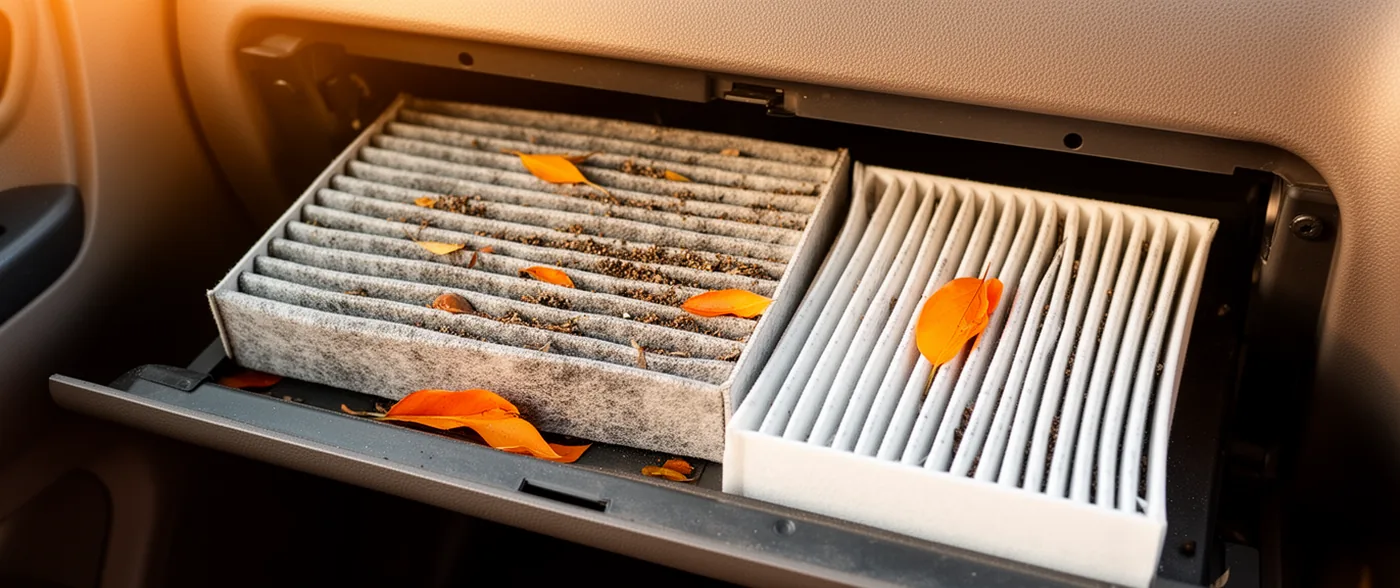
The check that beats any interval takes two minutes and costs nothing: pull the filter out and look at it. On most cars it lives behind the glovebox and comes out without tools. Grey and loaded means spent, whatever the odometer says.
The plug-in purifiers, measured
The small plug-in “car air purifiers” sold by the thousand have been measured, and the result is worth the price of the page:
Scale runs to 51 %, the highest measured value here.
use it Renck and Jung, Environmental Science: Processes & Impacts, The effect of portable air purifiers and cabin air filters on particulate matter and nitrogen oxides concentrations in vehicle cabins, September 2025. Peer-reviewed. Particulate matter and nitrogen oxides measured inside vehicle cabins across a range of HVAC fan speeds, all in fresh-air mode, comparing the car's own filter against OEM and aftermarket filters with carbon layers and against portable purifiers from about 80 to 8,500 litres per minute. The authors state this is the first study to show that built-in cabin filters can be highly inefficient at high fan speed.
A unit moving about 270 litres per minute — roughly 10 cubic feet per minute — produced no measurable reduction over the car’s own filter. The plug-in unit moving about 1,400 lpm (60 CFM) cut the index by 37 per cent on a low fan setting and 51 per cent on medium. The authors put the minimum effective flow rate somewhere between 10 and 60 CFM.
So the specification to look for on any in-car purifier is airflow in CFM or litres per minute, and most cup-holder devices either do not publish one or publish a figure below the level at which anything was measured to happen. A device that does not state its flow rate is not making a claim you can check.
What to actually buy
Cabin filters are specific to your car, so the link below is a fitment search rather than one listing. What the measurements say to choose, once you are looking at the ones that fit:
- An activated carbon layer, if traffic fumes are your problem. It is the difference between 64–67 per cent NO2 reduction and none.
- The deeper pleat of two that fit. More area measured better on filtration, airflow and life simultaneously.
- Not the cheapest. This is the one category on this site where the budget option was measured doing nothing at all for one of the two things it is sold to do.
- Carbon cabin air filters on Amazon Filter to your vehicle first — fitment decides this
Affiliate links — we earn a commission at no extra cost to you and it does not change what we recommend. How this site makes money.
What nobody has measured
- Filters sold in the United States. The 22-filter study measured filters on the Chinese market, and its service-life hours are modelled on Chinese cities. The physics and the ranking carry over; the hours do not, and no equivalent survey of US-market filters exists that we could find.
- Your car at your fan setting. The fan-speed effect was measured, but not as a published curve you could look your own car up on. Nobody can tell you what a specific car loses between fan speed two and speed four.
- Whether recirculate is better on balance. It cuts what comes in from outside and it also traps what builds up inside, including carbon dioxide from the people in the car. No study we found measures that trade-off over a normal commute.
- The rest of car cleaning. Soaps, waxes, wheel cleaners and microfibre towels are sold on numbers — pH, GSM — that nobody has tested against an outcome. Where we cannot find a measurement, we do not rank the products, and that is why this section has a cabin-air page and no shampoo page.
use it Renck and Jung, Environmental Science: Processes & Impacts, The effect of portable air purifiers and cabin air filters on particulate matter and nitrogen oxides concentrations in vehicle cabins, September 2025. Peer-reviewed. Particulate matter and nitrogen oxides measured inside vehicle cabins across a range of HVAC fan speeds, all in fresh-air mode, comparing the car's own filter against OEM and aftermarket filters with carbon layers and against portable purifiers from about 80 to 8,500 litres per minute. The authors state this is the first study to show that built-in cabin filters can be highly inefficient at high fan speed.
use it Wang et al., Environment International, Investigating the filtration performance and service life of vehicle cabin air filters in China, August 2024. Peer-reviewed and open access. Twenty-two vehicle cabin air filters measured for filtration efficiency, pressure drop at an air velocity of 2.5 m/s, and dust-holding capacity, plus modelled service life across 31 major Chinese cities. The filters are those sold in the Chinese market and the service-life hours are specific to those cities' air, so the physics and the ranking travel but the absolute hours do not.
arithmetic The multiples — 2.2× the area, 37 per cent better filtration, -35 per cent pressure drop, 4.9× the service life — are ours, computed from the figures each paper states. The underlying values are theirs.
regulation Wang and colleagues also record two regulatory floors rather than test results: Beijing requires a PM2.5 filtration efficiency of at least 88.1 per cent and Liaoning at least 97.5 per cent. Those are requirements placed on filters sold there, not measurements of the 22, and no equivalent US requirement exists.