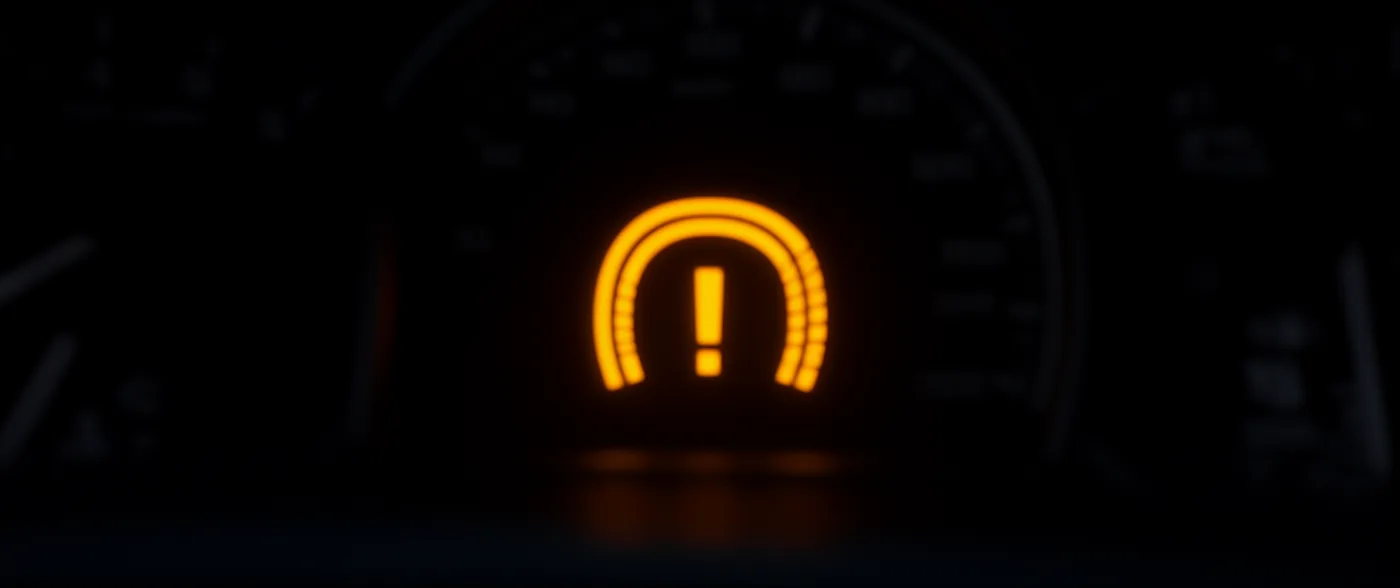
The light came on this morning. It is not just the cold.
Search this and every answer says the same thing: air contracts when it is cold, the light will go off once the tyres warm up. The first half is true. The second half is bad advice, and two published numbers show why in about a minute of arithmetic.
What the cold actually costs
A tyre is a sealed vessel, so pressure and absolute temperature move together — drop the temperature by a given fraction and the absolute pressure falls by the same fraction. Working that through at normal car pressures:
Scale runs to 1.11 psi, the highest figure here.
arithmetic Ours, not a measurement: the gas law applied to the placard pressures beside each bar, at 70 °F falling to 60 °F, with 14.696 psi added and removed to work in absolute pressure. Every step is on this page and you can redo it.
So the rule of thumb everybody quotes — about a psi for every ten degrees — is right, and it is worth knowing that it is slightly larger on a higher-pressure tyre. A 44 psi placard loses 1.11 psi where a 32 psi one loses 0.88.
When the lamp is required to light
Now the part the advice leaves out. Every passenger vehicle sold in the United States since 2007 is built to a federal standard that fixes when the low-pressure lamp must illuminate: 25 per cent below the placard pressure. It is not a manufacturer's choice or a sensitive sensor.
| Placard | Lamp lights at | Pressure gone |
|---|---|---|
| 32 psi | 24.0 psi | 8.00 psi |
| 35 psi | 26.3 psi | 8.75 psi |
| 44 psi | 33.0 psi | 11.00 psi |
Put the two together
A 35 psi tyre must lose 8.75 psi before the lamp is required to light. Cold costs about 0.94 psi per ten degrees. Temperature alone would therefore need a fall of roughly 94 °F to do it — not overnight, and not in a single season.
A full summer-to-winter swing — say 90 °F down to 20 °F, which is seventy degrees — costs about 6.3 psi. That takes a correctly inflated 35 psi tyre to roughly 28.7 psi: low, worth correcting, and still above the 26.3 psi at which the lamp is obliged to come on.
So if the lamp is lit, the cold is not the whole story. Either the tyre was already meaningfully under-inflated before the cold snap, or it is losing air. Driving until the lamp goes out warms the air enough to hide the reading — it does not put the air back.
What to do this morning
- Check all four cold, before driving, with a gauge rather than the dashboard. Placard pressures are specified cold, which means ambient — not warmed by three miles of road.
- Set to the placard on the driver's door jamb, not to the number moulded into the tyre sidewall. The sidewall figure is the tyre's maximum, not your car's specification.
- Note which tyre was low. If one is consistently the odd one out, that is a leak, and no amount of topping up is a repair.
- Re-check in a week. A tyre that is soft again has a hole; a set that has all drifted down together has simply been ignored, and a slow universal loss of one to two psi a month is normal.
Doing this in a supermarket forecourt in February is how it gets put off, which is the real argument for keeping a pump in the boot. Car and Driver timed six of them: the quickest reached 30 psi in 1:34 and the slowest took 6:40, and a calculator here scales those times to your own tyre size.
use it Car and Driver, Best Portable Tire Inflators of 2026, Tested, 17 February 2026. One tyre on one vehicle: a 245/50R20 on a 2023 Hyundai Santa Cruz, let down to 10 psi on a handheld gauge, then each inflator timed to 30 psi and again to 45 psi. Noise averaged in dBA and sone over 15 seconds of running. Each unit's own gauge was checked against the handheld one before and after.
Where the retailers disagree
The two tyre retailers ranking highest for this question do not agree with each other. Les Schwab publishes about 1 psi per 10 °F; Ok Tire publishes 1 to 2 psi for the same ten degrees. Neither shows a calculation.
The arithmetic above puts it at 0.88 to 1.11 psi across normal placard pressures, so the first is right and the second is roughly double at its upper end. We are not merging them into an average: one of them matches the physics.
the rule US federal motor vehicle safety standard, FMVSS 138 — tyre pressure monitoring systems, in force since 2007. The standard every passenger vehicle sold in the United States is built to: the low-pressure telltale must illuminate when a tyre falls to 25 per cent below the vehicle placard's cold inflation pressure, or to a minimum pressure specified in the standard, whichever is higher. It is a legal threshold rather than a manufacturer's choice, which is why the same arithmetic applies to almost any car on American roads.
marked Les Schwab, TPMS Light and Cold Weather, 2026. A tyre retailer's guidance, stating that pressure falls about 1 psi for every 10 degrees Fahrenheit the temperature drops. A competing retailer, Ok Tire, publishes 1 to 2 psi for the same 10 degrees. Neither shows the calculation.
arithmetic The pressure figures on this page are computed, not cited: a sealed volume obeys P₁/T₁ = P₂/T₂ in absolute units, so 14.696 psi is added to each placard pressure and Fahrenheit converted to kelvin before the ratio is taken. The numbers are generated when the page is built, so the text and the sums cannot drift apart.