A fifth of the light you paid for.
AAA had an accredited laboratory measure headlight assemblies from two sedans of about eleven years old against new ones, to the federal headlight standard. On low beam the aged lenses produced 22 per cent of what a new headlight does. Not dimmer. A fifth.
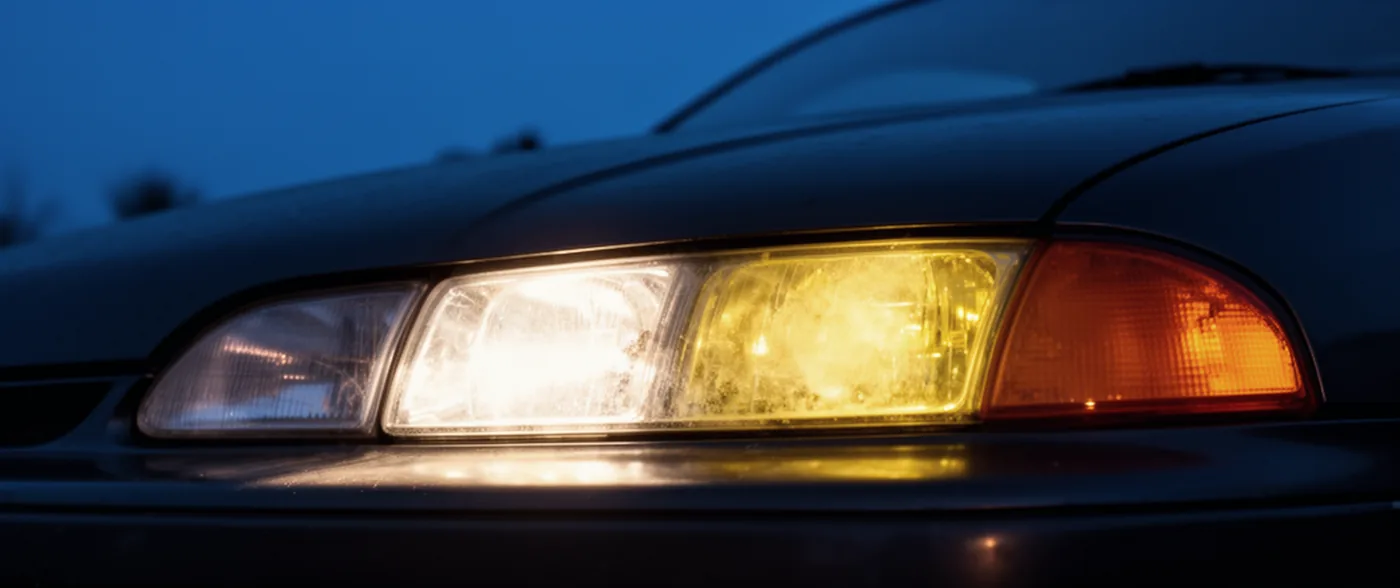
A fifth of the light you paid for
The cause is sunlight rather than mileage. The plastic lens carries a protective coating, ultraviolet light breaks it down, and the polycarbonate underneath clouds and yellows. AAA reports that this can begin as early as three to five years depending on where and how the car is kept — which is well inside the life of a car nobody thinks of as old.
It is also the failure nobody inspects. People check tyres and batteries; almost nobody looks at a headlight until it is visibly yellow, by which point the measurement above has already happened. The check is free and takes ten seconds: if you cannot clearly see the bulb and reflector through the lens, the lens is the problem.
The rare case where it reaches a crash statistic
Most of this site stops at a measurement, because that is usually where the published evidence stops. Headlights are the exception. Separately from AAA’s work, a peer-reviewed study related IIHS’s headlight visibility ratings to police-reported nighttime single-vehicle crash rates per mile driven, holding daytime rates constant.
One rating band of improvement — ten visibility demerits — was estimated to cut the nighttime crash rate by 4.6 per cent (95% confidence interval 2.1 to 7.0). Good-rated headlights were estimated at 12 to 29 per cent lower crash rates than poor-rated ones, though the author is explicit that statistical significance was limited by small sample sizes for that second comparison, and we repeat it here for the same reason he wrote it.
One caveat is ours and matters: that study is about the headlights cars are built with, not about the condition of an ageing lens. It does not measure your restoration. What it does establish is that headlight visibility is not a comfort feature — it moves a crash statistic.
Four options, all measured
Scale runs to 100 %, the highest measured value here.
use it AAA, AAA Illuminates the Dangers of Driving with Cloudy Headlights, December 2018. An accredited testing laboratory measured headlight assemblies from two popular sedans of about eleven years of age, driver's-side units, against new ones, to FMVSS-108 with no modification to the assemblies or the procedure. Output was measured again after replacement with original-equipment parts, after replacement with aftermarket parts, and after both professional and DIY restoration. Two vehicles is a small sample and the study is from 2018; the figures are the ones AAA published.
- Original-equipment replacement 4.5× Measured back to full output
- Aftermarket replacement 3.8×–4.1× 83–90%, but failed some intensity requirements
- Restoration, professional or DIY 3.2× About 70%, and more glare than DOT allows
Multiples are ours, against the 22 per cent an aged lens measured. Even the weakest option is a large improvement on doing nothing — which is the honest case for the cheap fix, and the reason the next section exists.
The part the kit does not mention
AAA measured both professional and DIY restoration producing more glare than DOT criteria accept. Not one method — both. The aftermarket replacement lenses were also found more likely to glare, and failed certain light-intensity requirements, despite reaching 83–90 per cent of output.
That is a real cost paid by the driver coming the other way, and it is not on the box. Restoration works by sanding the failed coating off and polishing the polycarbonate; the optics that used to control where the light went are part of what gets removed. You get more light out and less control over where it lands.
It does not make restoration the wrong choice — going from 22 per cent to about 70 is a 3.2× increase in what you can see, and AAA calls it the most cost-effective option while still recommending replacement. But it means the honest sentence is “this triples your light and worsens your glare”, not “restores like new”. If a kit includes a UV-blocking sealant step, use it: without one the fresh polycarbonate is unprotected and will cloud again.
What to buy
Replacement assemblies are specific to your car, so that is a fitment search. Restoration kits are largely universal, and they are the option most people will actually take.
- Headlight restoration kits on Amazon About 3.2× the light of a degraded lens — choose one with a UV-blocking sealant step, and accept the glare finding above
- Replacement headlight assemblies on Amazon Filter to your vehicle. Only original-equipment parts measured back at 100%
Affiliate links — we earn a commission at no extra cost to you and it does not change what we recommend. We are recommending the cheaper option knowing it is the weaker one, and saying so. How this site makes money.
What nobody has measured
- How long a restoration lasts. AAA measured output right after the work. Nobody has published how quickly a resanded lens re-clouds, with or without a sealant, which is the figure that decides whether the cheap route is cheap.
- Which kit. The measurement covers restoration as a method, not brands. No independent test we could find compares kits against each other, so we are not ranking them.
- Your car. Two sedans, driver’s side, in 2018. The failure mechanism is general; the exact percentages belong to those two cars.
- What restoration does to a crash rate. The crash study concerns headlight designs as built. Nothing published connects a restored lens to an outcome, so the two halves of this page meet in the middle and do not join.
use it AAA, AAA Illuminates the Dangers of Driving with Cloudy Headlights, December 2018. An accredited testing laboratory measured headlight assemblies from two popular sedans of about eleven years of age, driver's-side units, against new ones, to FMVSS-108 with no modification to the assemblies or the procedure. Output was measured again after replacement with original-equipment parts, after replacement with aftermarket parts, and after both professional and DIY restoration. Two vehicles is a small sample and the study is from 2018; the figures are the ones AAA published.
use it Brumbelow, Journal of Safety Research, Light where it matters: IIHS headlight ratings are correlated with nighttime crash rates, December 2022. Peer-reviewed. Poisson regression relating IIHS headlight visibility ratings to police-reported nighttime single-vehicle crash rates per vehicle mile travelled, controlling for daytime rates and other factors. The author notes that statistical significance was limited by small sample sizes for the good-versus-poor comparison, and the study concerns the headlights vehicles are built with rather than the condition of an ageing lens.
arithmetic The multiples against 22 per cent are ours. Note that AAA’s own headline rounds the degraded figure to 20 per cent while the body of the release gives the measured value as 22; we use the measured one throughout.